Hey superstars. I want to give you a quick overview of the Listen & Repeat and Interview tactics I’m seeing work right now in My Speaking Score data. It's working great for my coaching clients.
This post is about three things:
- Using images and short-term memory to remember the sentence more reliably
- Using rhythm and stressing to raise Listen & Repeat scores
- Structuring and delivering higher-scoring Interview task answers
1) Listen & Repeat: Exaggerated rhythm is getting higher scores
I’ve been experimenting inside My Speaking Score with the Listen & Repeat task, and I’ve been doing some crazy stuff: emphasizing, stressing, overstressing, exaggerating rhythm.
The big insight: flat delivery isn’t rewarded.
Example of a flat delivery:
- Welcome to the international airport.
A more rhythmic delivery that the scoring engine seems to reward:
- WELCOME to the interNATIONAL AIRport.
That second version can sound weird in daily life. But the scoring engine, which is still very new, appears tuned to reward hard-core rhythm and strong stress patterns.
Stress the hell out of content words
In Listen & Repeat, stress the content words (nouns, main verbs, adjectives, adverbs). These are the words that carry meaning.
Example: “welcome” is two syllables, and the first syllable is stressed.
- Normal daily English: welcome
- What I want you to test inside My Speaking Score: WELcome
Try this idea with longer sentences too:
- Carry-on liquids must be placed in clear plastic bags.
Now test an exaggerated version where you hammer the content words:
- CARRY-on LIQUIDS must be PLACED in CLEAR PLAS-tic BAGS.
Overemphasize. Overdo it. See what happens to the score. Keep experimenting.
2) Use the image as a short-term memory tool (especially after #3)
The other thing I want to mention: leverage the image.
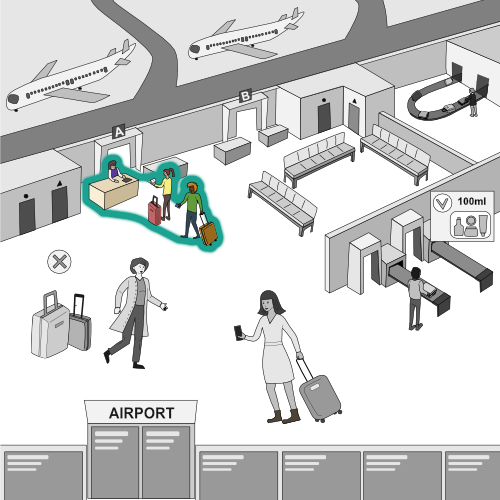
The image isn’t just decoration sitting above the prompt. It has assessment value because it can help you remember the key content words while you’re listening.
What I’m seeing in the data:
- The first three Listen & Repeat items are usually simple and high scoring
- Then people fall off a cliff around the fourth one
If that sounds familiar, try this technique.
The image locking technique
As you listen, lock in to the image and use it to anchor the content words.
Example:
- Please have your boarding passes and identification.
That phrase is easy to lose under pressure. So while listening, stare at the image and attach the words to what you see:
- boarding passes and identification
- boarding passes and identification
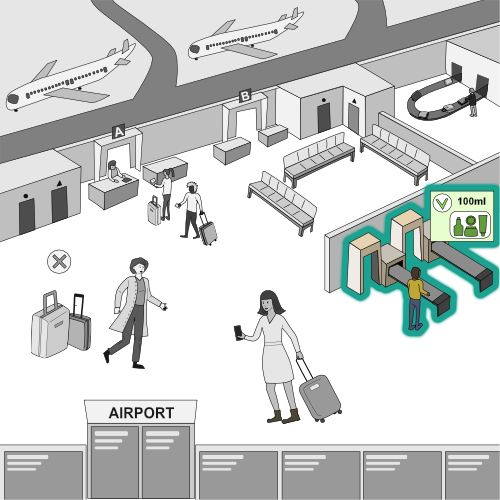
Another example:
- Carry-on liquids must be placed in clear plastic bags.
Use the image to visualize the action. Picture the person placing liquids into a clear plastic bag. Make the image do work for you.
You don’t need to speak immediately after the beep
It’s not necessary to start speaking the instant you hear the beep.
Sometimes it can help your short-term memory if you pause briefly, collect your thoughts, then deliver cleanly.
If you make a mistake, don’t self-correct
If you slip, don’t double back to fix it. Self-correction usually causes more harm than good.
Just keep going and finish the sentence strong.
Example:
- Carry-on liquids have to be… I mean, must be…
That kind of repair can kill your flow. A better move is to keep plowing through:
- Carry-on liquids have to be placed in clear plastic bags.
3) While reviewing, mark where stress should go
When you review the text in the side drawer, try to identify where the stress should be.
Use the sentence to plan your stress targets:
- Carry-on liquids must be placed in clear plastic bags.
Then test it with exaggerated stress. Watch how the score changes. This is controlled experimentation:
- attempt
- score feedback
- adjust
- attempt again
4) Interview tasks: Use ABCD to build high-scoring answers
For Interview tasks, I’m working with a simple idea I’m developing: ABCD.
To score high, you must:
- Answer the question
- Explain yourself
- Clarify what you mean
- Go deep with specific details instead of skimming the surface or listing reasons
That’s ABCD:
- A: Answer
- B: Because (explain)
- C: Clarify
- D: Deepen
5) Interview questions usually fall into three types
Whenever you hear a question in the Interview task, it’s usually one of these:
- Past: remember a time, tell a story
- Preference or opinion: agree/disagree, what do you prefer, what do you think
- Future: predict, imagine, what will happen
If you can identify the question type quickly and then run ABCD, you have a framework that fits almost any prompt.
6) Example: Past question (routine disrupted)
Example prompt:
- Can you think of a time when your regular daily routine was disrupted, maybe due to travel, illness, or a special event? Describe what happened and how it ended.
This prompt tells you what “well-developed” means:
- You must describe what happened
- You must give details
- You must explain how it ended
A high-scoring response checks those boxes with specifics.
7) Example: Opinion / paired choice question (morning routine)
Example prompt:
- Many people believe that having a consistent morning routine helps them feel more focused and organized throughout the day. Others say routines don’t matter, as long as you get your stuff done. What do you think?
First, choose a side clearly.
Second, reuse the key language from the prompt. If it says “focused and organized,” those ideas should show up in your answer directly or thematically:
- focused, on task, concentrated
- organized, planned, structured
Third, go deep. Don’t list benefits.
A weak approach sounds like a checklist:
- Routines keep me focused. They keep me organized. They’re predictable. They help me use my calendar.
A stronger approach goes deep on one idea with a specific example:
- Explain your routine.
- Explain what you do.
- Explain how it keeps you focused and organized.
- Give a concrete detail (tools, habits, a real scenario).
Depth beats lists.
8) Delivery target: build toward 150 words per minute
In the Interview task, you need to keep talking. Build your speaking rate toward 150 words per minute.
That doesn’t mean rushing. It means:
- fewer long pauses
- smoother flow
- sustained development of one main idea